The Bubonic Plague played a crucial role in life during the Fourteenth Century. One could make the argument that the death and suffering caused by the epidemic became mainstream culture, especially in Europe. As with many mainstream phenomena, the Plague heavily influenced the arts and humanities from this time period. There is a plethora of research on how the disease became a common motif in European art. However, there is less research on how the Plague had an impact on parts of the Eastern world.
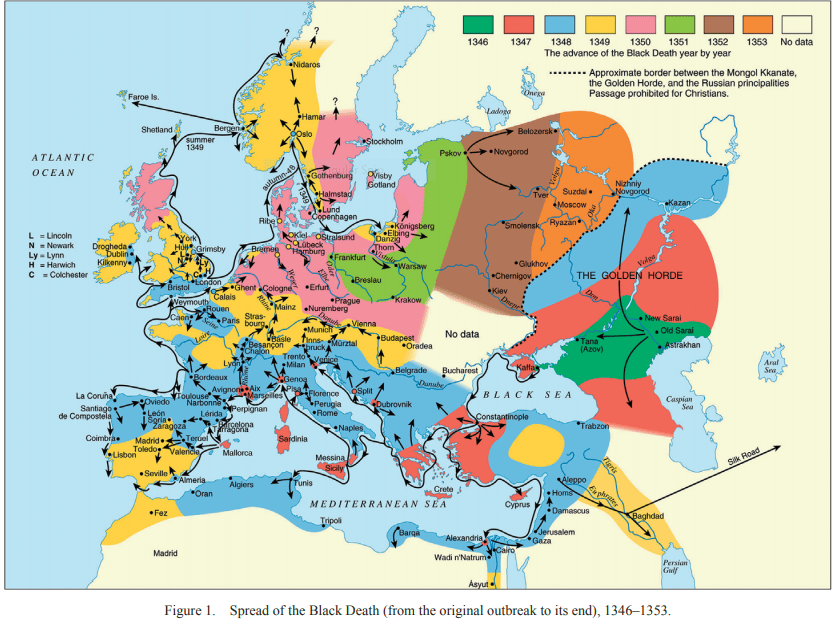
In order to understand how the Plague affected the world and their art, I first wanted to learn more about this epidemic and how it spread. I used this map in order to visualize the spread of the Black Death into Europe over time. The citation for this source is Cesana, D., et al. “The Origin and Early Spread of the Black Death in Italy: First Evidence of Plague Victims from 14th-Century Liguria (Northern Italy).” Anthropological Science, vol. 125, no. 1, 16 Oct. 2016, pp. 15–24., http://www.jstage.jst.go.jp/article/ase/125/1/125_161011/_article/-char/en. In most cases, I use the Kent Library database to find the vast majority of my resources. In this case, I did use Google to search for maps. Then I sifted through the many maps until I found one with relevant information and from a scholarly source. I am fairly certain the source I found this map from is scholarly because the authors’ credentials are located right below their names, it was published in a journal, and was published online on a database used for the spreading of information on science and technology within Japan. In addition, this article was published on J-Stage in 2017, so the information is still fairly up to date. I mostly used this source for the map, but there is an entire article that goes along with it. The main argument that the authors’ are making is that ‘ospital’ of San Nicolao, which is located in Genoa, Italy, served as an epicenter for the Bubonic Plague and helped facilitate the spread of the disease throughout Europe. The evidence used to support this thesis is that bustling port cities like Venice and Genoa imported the disease from rats on merchant ships and then exported those same rats to other parts of Europe. Those affected by the disease were sent to the ‘ospital’ and even buried on those grounds once they succumbed to the Plague. From these areas, the disease exploded across Europe. In order to support this argument, archaeological data is used from an excavation campaign in Genoa from 2001 to 2006. The mass burial sites and genetic information from the corpses help further their argument that the remains found in these graves died of Y. Pestis at the beginning of the outbreak. Further research goes on the show how the disease spread along trade routes from Genoa to the rest of Europe. The lens this article uses is a scientific one. This article is less focused on the history of the spread of the Plague and more on the biology of how the pathogen could spread. One key aspect of this whole article is the statement that the Plague came to Europe from Crimea. This statement is not supported by further research in the article because it seems to be the general consensus of the historical discussion. Nonetheless, this statement, as well as the map, gives me the gateway to the East to research where the disease spread before reaching Italy. If I know where the Plague was before roughly 1346, I can search for art from areas like Crimea and farther East in the earlier Fourteenth Century.
Before delving into my secondary source research that tries to put the effects of the Plague on art outside the Eurocentric perspective, I first want to showcase my findings that do fit into that lens.
One Eurocentric source I found was using JSTOR through Kent Library. Its citation is as follows, Boeckl, Christine M. “Giorgio Vasari’s “San Rocco Altarpiece”: Tradition and Innovation in Plague Iconography.” Artibus Et Historiae 22, no. 43 (2001): 29-40. doi:10.2307/1483649. I believe this is a scholarly source since I found it on JSTOR and was published by the IRSA (an Italian acronym that translates to the Institute for Art History Research). From my previous knowledge of the Fourteenth Century and the Plague Era, I know that the vast majority of people from this time period believed the Black Death was the wrath of God and some form of punishment. Boeckl is making the argument that in Vasari’s Iconography of the Plague diverges from that traditional idea. Rather than the suffering caused by the disease being a punishment, Boeckl states that Vasari is depicting the Plague as more of a test from God in order to reward the people once they overcome their suffering. In order to make this argument, the author visually analyzes Vasari’s Iconography. She unpacks all of its elements to explain how these images are more about hope than suffering. The images she uses are digital copies of primary sources. From what I can tell, the author is using religion to analyze the primary sources. By religion, I mean Boeckl is objectively using her knowledge of Biblical texts and how integral religion was to the Medieval Period in order to try and figure out the messages Vasari was trying to spread with his art. In addition, Boeckl juxtaposes Vasari’s work to other works of art from the time period. The reason why I included this source in my research is because it strays away from the typical art that was influenced by the Plague. These works of art were created several decades after the Black Death, so I think it is interesting to look at how artists were still influenced by the Plague after quite some time has passed and how the views on the Plague had shifted from focusing on suffering and punishment to resilience and faith. This perspective is valuable to my research because it allows me to build on the fact that the Black Death had a lasting impact on society, culture, and especially art.
The next Eurocentric source I used was also found on JSTOR. This is the citation: Marshall, Louise. “Manipulating the Sacred: Image and Plague in Renaissance Italy.” Renaissance Quarterly 47, no. 3 (1994): 485-532. doi:10.2307/2863019. I know that this is a scholarly source because it was published by Cambridge University Press. I have been taught that University Presses are generally peer reviewed and trustworthy sources. In this article, Marshall makes the argument that researches can get a good grasp on the lasting psychological effects of the Black Death by analyzing their art and the images they created. She later goes on to argue that many of the art created during this time period is not what most people think. As I stated before, I was under the impression that the general argument about this time period is that the people of the Fourteenth Century believed they were being punished by the Plague. While Marshall does not refute this idea, she claims that their art was less about punishment and suffering and more about the people of this time period finding different ways to appeal to the heavens for divine intervention so they could regain control of their environment, Marshall makes this argument by visually analyzing primary sources in a way that refutes other historians arguments. The primary sources she uses are various pieces of artwork. The author takes on a psychological perspective to try and understand how the people living through the Plague were coping with the disease. I was caught off guard to find another valuable source that refuted the general beliefs around this field of study. I will use this source in my research by how Marshall makes the people the Fourteenth Century not that different from today. She explains how these people were trying their best to regain control of their environment. During this time period, people often turned towards religion and divine intervention to answer their problems. This is why many of the images hey produced may seem hopeful. If there were a massive epidemic today, most people would hope that medicine and antibiotics could solve their problems. This article has helped me realize that the people living through this time period were not just illogical religious fanatics, they were turning to the best options they had available to them. I am hoping to remember this sentiment and see if this dark hopefulness is common in Eastern art from the Fourteenth Century as well.
The next source I found provides me with a more global perspective. As I have uncovered from my other sources, the understanding among historians and scientists alike is that the Plague (Y. Pestis) originated in East Asia. The source (Wiechmann, Ingrid, Ole Jørgen Benedictow, Raffaella Bianucci, and Sacha Kacki. “History of the Plague.” RCC Perspectives, no. 3 (2012): 63-74. http://www.jstor.org/stable/26242596.) argues how the Black Death found its way back into Europe. There have been various outbreaks of the Plague for centuries, but Weichmann argues that the epidemic in the 1300s most likely traveled from rats and fleas in East Asia to cities in the Middle East before reaching the port cities of Italy. This makes sense as trade needs to pass through the Middle East in order to go West. To contribute to her argument, the author claims that the Middle Eastern cities provided the breeding ground for the disease to mutate into a form that could sweep through Europe. The reason why these cities were a key point in the spread is because their populations were big enough for the disease to grow. This source is from 2012 and feels slightly dated. I think this may because the author is taking on a historical perspective to explain the spread. Because of this, it seems that Wiechmann is more so proposing a hypothesis as to how the disease spread rather than making a strong argument claiming it swept through Middle Eastern cities before reaching Europe. She backs up her historical perspective with other researchers who have proposed the same idea, but she does not use archaeological data or primary sources. As I result, I do not think I will use this source too directly in my research paper. I think it is useful to have a source that explains that the disease originated in the East, but she does not talk about art or culture anywhere in her article. Her claims about the Middle East will simply give me more ideas as to where I should be looking for art and other primary sources.
The final secondary source I found a book I found on Google Scholar. I really try to avoid using Google and try to stick to using Kent Library’s databases. I was struggling to find secondary sources that talk about the Plague outside of Europe. I know the Black Death had multiple epidemics throughout history and it’s process into Europe was not linear. However, I was hoping to find more scholarly literature on the Black Death in Asia around the Fourteenth Century. This book focuses on the Plague in the Middle East during the Fourteenth Century. Here is the citation, Dols, Michael Walters. Black Death in the Middle East. S.1.: Princeton Univ Press, 1977. The author goes on to explain how there is very little literature on the Black Death outside of Europe. Dols argues that this is because there is little interest in translating and analyzing Arabic texts from this time period. From his research, Dols, claims that many Muslim scholars also believed that the Plague was the wrath of god, just like the European’s believed. He supports his argument with primary sources and accounts from the texts from this time period. One concern I have with Dols is that he originally published this book in 1977. Because of this, the text could be outdated. Unfortunately, I am having a hard time locating secondary sources that are not focused on Europe. Despite this, I trust Dols argument. This source was published by the Princeton University Press, so there must be some merit to his claims. I appreciate the author’s attempt to break out of the Eurocentric research on the Black Death. His focus on the Islamic world’s approach to the Plague provides me with some crucial information to bring my own research into a global perspective. Another concern I realized after reading Dols was that I may struggle to find primary source art from the Middle East in the Fourteenth Century. This is because Islamic art does not depict Allah (God). It is against their religion to do so. If the Islamic world also believed the Plague was punishment from God, they may not create art that shows a divine being causing the disease. As a result, I may have to look for calligraphy from the 1300s in order to analyze how the Plague effected art in the Middle East. Calligraphy is its own special form of art in the Islamic world since they cannot personify their God through humanly depictions.

