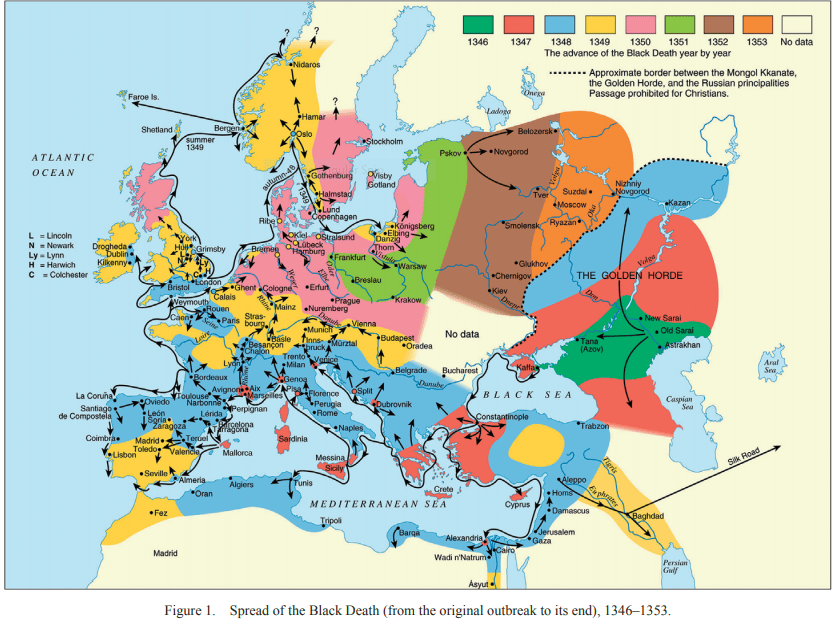
I ran into some trouble trying to find primary sources. I quickly realized after scouring Artstor that the vast majority of painted art depicting the Bubonic Plague in Europe was not created until the 15th Century. This lag in time between the Plague and its depiction (in Europe) is something I will take into consideration when I write the final draft of my research paper. So instead, I turned my attention to other forms of art that was created while the Plague was going on or shortly after. As for primary sources outside of Europe, I struggled to find a trend in art that relates directly to the Black Death in the Middle East. I did, however, find some first hand accounts of historians describing the Plague while it was going on in the city they were in. Meanwhile for the Yuan Dynasty in Asia, painters seemed to shift their artistic focus from human life to nature.
The first primary source I looked at was The Decameron by Giovanni Boccaccio. This book was written by an Italian author who lived through the Black Death in Italy. The book is about a group of people living in Florence, Italy in 1348. Boccaccio completed writing his book around 1853, roughly five years after the Black Death swept trough Florence. During the height of the Plague, ten young people decide to flee the city. Although this source is a fictional book, it still provides accounts of historically relevant information on the Plague from someone who lived through the disease in the same city. Boccaccio uses his knowledge of the Plague to craft these stories and descriptions. Since Florence was particularly impacted by the Black Death, Boccaccio’s experience is invaluable to the study of the Plague in Europe. I am using his descriptions in order to further my understanding of what it was like to actually live through the Black Death. In addition, The Decameron is a work of literary art from the time period. It is a perfect example of how art (in its many forms) was shaped by the Black Death. Also, the novellas within the The Decameron serve as essentially one hundred different stories from the time period rather than one single narrative. These many short stories provide vital glimpses into the different ways European individuals processed and dealt with the horrors of the Plague. Due to the abundance of stories within the book, one can analyze the full range of emotions felt by those who lived through the Plague. Some of the stories are deeply tragic and macabre, while others are humorous and lively. From this source, I realized that people had different outlets for their reactions. Boccaccio is actually somewhat critical of the Catholic church within many of the tales he wrote. This seemed odd since most of the physical artworks I could find from 14th century Europe were all religious in nature. One could make the argument from the Decameron that some people felt duped by the Church because they did not provide enough relief to the suffering of the Plague.
The next primary source I utilized was an excerpt from “An Essay on the Report of the Pestilence” by Ibn al-Wardi. Al-Wardi was an Arabic scholar who lived through, but did not survive, the Plague in Aleppo, Syria during 1348. In this essay, al-Wardi explains the movement of the Plague throughout the Middle East and what specific cities were effected. He even goes to great lengths to talk about how the people in Aleppo are attempting to treat the illness. Finally, al-Wardi pleads with God to end the suffering, which he believes is some sort of punishment. As I have continued my research, I have found that the vast majority of Europe also believed that the Plague was God punishing them. It was enlightening to read the words of a man describing the symptoms of the Black Death in Aleppo when he himself would succumb to the disease by 1349. Al-Wardi seems to believe that is is worthless to spend time trying to treat the disease with earthly things such as food or clay, but rather your fate is totally in the hands of God. He even criticizes scholars pouring over their medical textbooks. This leads me to believe that not everyone agreed with al-Wardi on the hopelessness of the Plague. I learned from Dr. McAlister that in Europe, many of the texts used in the 14th century by European scholars were ones preserved by Muslims. Because al-Wardi is in the Middle East, I wonder if the medical books he was referring to were related to the Humors and Galen. In Europe, the 14th century medical professionals thought you could treat the Plague by balancing out your four “humors”. Many the people eating onion and spreading clay on their buboes were also trying to accomplish that balance.
The third primary source I looked at was the works of art by Wang Meng (1308-1385), especially his Forest Grotto in Juqu piece. As I stated earlier, during the Yuang Dynasty, there was a shift in art from depicting social life to nature scenes. The Yuang Dynasty was affected by the Black Death, but its art is markedly different from that of Europe. European art went down a religious route, possibly because they some of them believed their piety determined whether or not they would contract the Plague. Wang Meng was the most famous artist from this time period and he only created nature scenes. His Forest Grotto piece is famous for pioneering a new heavier art style that many of Yuang Dynasty artists copied. The works of Wang Meng (many of which can be found on Artstor) are significant because they exemplify Asian reactions to the Plague. Rather than turning towards religion to deal with the stress of living through such a tumultuous time period, they found resolve in nature. Asian depictions of nature during this era also relate to the European sentiment that fresh-air and getting away from the cities could be good to avoid the Plague. This is exactly why the character’s in Boccaccio’s The Decameron flee Florence for the countryside. The Yuan Dynasty was neither a Christian nor Muslim society during this time. The most influential religion in the Dynasty was Tibetan Buddhism. Since this form of religion is more based on the individual and achieving inner peace rather than on omnipotent supreme being, it does not seem out of the ordinary for its art to manifest itself differently than that of European art. If the people of the Yuan Dynasty did not view the Plague as a punishment from God, but rather a form of miasma or corruption of nature, they may have turned to depicting beautiful, tranquil nature scenes. These scenes would have been a pleasant escape from the atrocious reality of the Black Death.
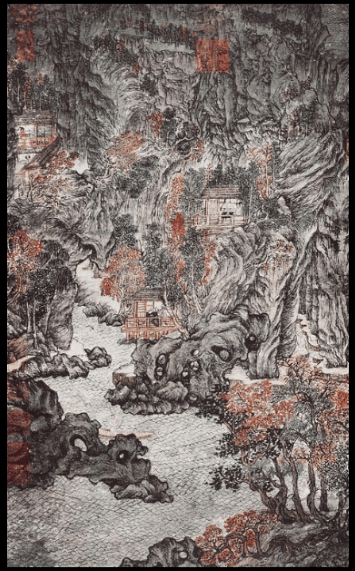
Forest Grotto in Juqu by Wang Meng, after 1368.
Sources
Boccacio, Giovanni. The Decameron. Translated by Wayne Rebhorn. New York: W.W. Norton & Company, 2013.
Ibn al-Wardi, An Essay on the Report of the Pestilence, 1348. http://wp.lps.org/lmann/files/2014/01/Black-Death-Primary-Documents.pdf
Wang Meng, 1308-1385. after 1368. Forest Chamber Grotto at Chu-Ch’u. hanging scroll. https://library.semo.edu/asset/ARTSTOR_103_41822001846839.